
The gaming industry is evolving faster than ever, and 2026 is shaping up to be a revolutionary year for gamers worldwide. What was once considered science fiction—hyper-realistic virtual worlds, AI-driven gameplay, and fully connected gaming ecosystems—is rapidly becoming reality.
In 2026, gaming is no longer limited to entertainment alone. It is influencing education, careers, social interaction, and even mental well-being. From next-gen consoles to cloud-powered experiences and immersive realities, the future of gaming promises deeper engagement, smarter systems, and a more inclusive global community.
This blog explores what gaming will look like in 2026, the technologies driving change, emerging trends, and how gamers can prepare for what’s coming next.
The Evolution of Gaming Technology in 2026
By 2026, gaming hardware and software will reach new heights of efficiency and realism. Game engines will deliver cinematic-quality visuals with minimal performance cost. Real-time ray tracing, AI-enhanced textures, and advanced physics systems will create worlds that feel alive.
Artificial intelligence will play a central role in game development. NPCs will react emotionally, adapt to player behavior, and evolve over time. Instead of scripted responses, characters will learn from interactions, making every playthrough unique.
Loading screens will become nearly invisible thanks to ultra-fast storage and cloud-assisted processing. Games will feel seamless, fluid, and uninterrupted.
Cloud Gaming Becomes the New Standard
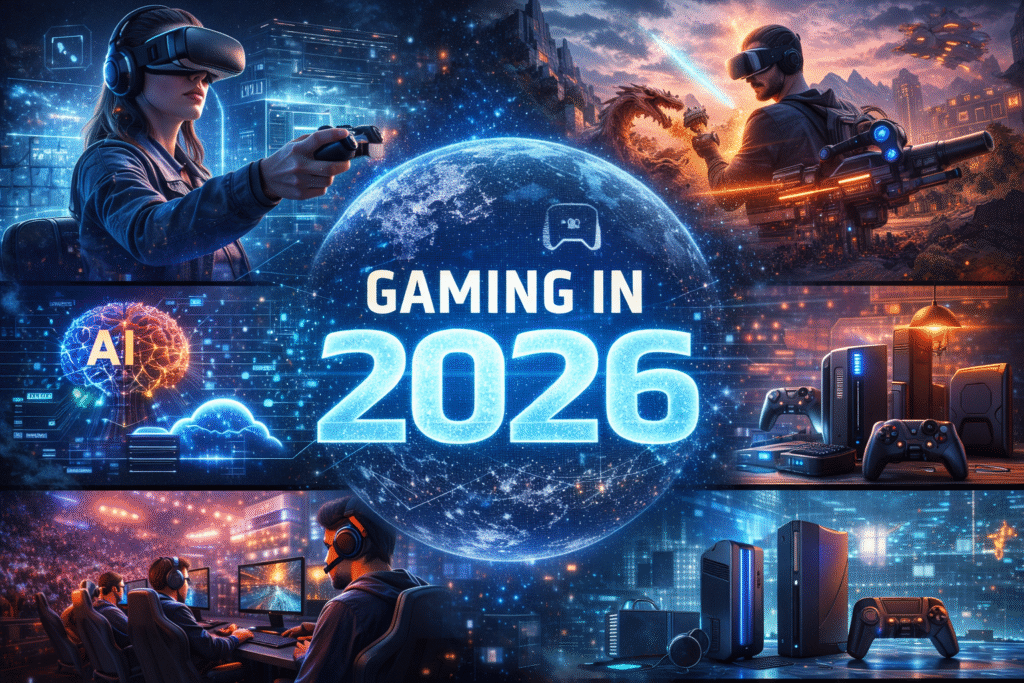
In 2026, cloud gaming will no longer be an alternative—it will be mainstream. Players will be able to stream high-end games on low-spec devices, including smartphones, tablets, smart TVs, and budget laptops.
This shift will remove hardware limitations, making gaming more affordable and accessible. Gamers will no longer need expensive upgrades to enjoy AAA titles. All that will be required is a stable internet connection.
Cloud saves, cross-device progress, and instant game access will redefine convenience. The idea of installing massive game files may soon become outdated.
Virtual Reality (VR) & Augmented Reality (AR) in 2026
Virtual Reality and Augmented Reality will see major adoption in 2026. Lightweight VR headsets with higher resolution and wider field of view will provide unmatched immersion. Players won’t just control characters—they’ll be inside the game.
AR gaming will blend real-world environments with digital gameplay. Living rooms, streets, and open spaces could become interactive gaming arenas. Fitness-based AR games will encourage movement, combining health and entertainment.
Social VR spaces will allow players to meet, play, and attend virtual events together, strengthening global connections.
AI-Driven Gameplay & Personalized Gaming
AI in 2026 will personalize gaming experiences like never before. Games will adjust difficulty, pacing, and storytelling based on player preferences and skill level.
Storylines may change dynamically depending on player decisions, emotions, and play style. AI-generated missions, characters, and environments will provide endless replayability.
This level of personalization ensures that no two gamers experience the same journey, making gaming deeply personal and engaging.
Esports and Competitive Gaming in 2026
Esports will continue its rise as a global phenomenon. By 2026, competitive gaming will rival traditional sports in viewership, sponsorships, and professional opportunities.
Advanced analytics, AI coaching tools, and performance tracking will help players train smarter. Grassroots esports programs will emerge in schools and colleges, creating clear career pathways.
Mobile esports will also gain massive popularity, especially in emerging markets, expanding competitive gaming’s reach worldwide.
Gaming Careers & Digital Economy
Gaming in 2026 will offer more career opportunities than ever. Beyond professional players, the industry will thrive with developers, designers, streamers, analysts, community managers, and virtual event organizers.
In-game economies, digital assets, and creator marketplaces will allow players to earn through creativity and skill. User-generated content will become a major pillar of game ecosystems.
Gaming will no longer be seen as “just a hobby” but as a legitimate and respected profession.
Gaming as a Global Social Platform
By 2026, games will function as social platforms where players hang out, communicate, and collaborate. Virtual concerts, live events, and digital meetups will become common.
Cross-platform play will fully unite PC, console, and mobile players, breaking down barriers. Language translation tools powered by AI will make global interaction easier than ever.
Gaming communities will continue shaping online culture, creativity, and digital identity.
Online Safety, Ethics & Responsible Gaming
With greater connectivity comes greater responsibility. In 2026, developers will focus heavily on online safety, data protection, and ethical design.
AI moderation tools will reduce toxicity and cheating. Parental controls, screen-time management, and mental health awareness will become standard features.
Responsible gaming practices will help ensure that gaming remains a positive and healthy experience for all age groups.
What Gamers Should Expect in 2026
- Ultra-realistic visuals and physics
- Seamless cross-platform gaming
- Smarter AI-driven worlds
- Mainstream VR and AR adoption
- Expanded esports and gaming careers
- Greater accessibility and inclusivity
Gaming will feel more immersive, social, and meaningful than ever before.
The Future Is Playable
Gaming in 2026 represents more than technological advancement—it reflects how digital experiences shape human connection, creativity, and entertainment.
As boundaries between reality and virtual worlds continue to blur, gaming will redefine how we play, learn, and interact. Whether you’re a casual gamer or a competitive professional, the future of gaming is bright, exciting, and full of possibilities.
Gaming Hardware in 2026: Smarter, Smaller, Stronger
By 2026, gaming hardware will focus heavily on efficiency and intelligence rather than just raw power. Consoles and PCs will become more compact while delivering significantly higher performance. Advanced cooling systems, AI-assisted performance tuning, and energy-efficient chips will allow devices to run cooler and quieter.
Controllers will evolve with biometric feedback, detecting player stress levels, grip pressure, and reaction speed to adjust gameplay dynamically. Wearable gaming accessories such as smart gloves and motion sensors will enhance realism, especially in VR and AR games.
For PC gamers, modular hardware will gain popularity, allowing easy upgrades without replacing entire systems. This shift will make gaming setups more sustainable and cost-effective.
Ultra-Fast Connectivity & Low-Latency Gaming
Internet infrastructure will play a massive role in shaping gaming in 2026. With wider adoption of ultra-fast broadband and next-generation wireless networks, latency issues will become far less noticeable.
Real-time multiplayer games will feel smoother, more responsive, and fairer. Competitive gaming will benefit the most, as milliseconds can decide victories. Cloud gaming platforms will rely on edge computing to deliver near-console-level responsiveness.
This improvement in connectivity will also enable massive shared worlds where thousands of players can interact simultaneously without performance drops.
AI Companions & Emotion-Aware Games
One of the most exciting developments in 2026 gaming will be AI companions that feel genuinely alive. These companions will remember past interactions, develop personalities, and react emotionally to player decisions.
Games may adapt their tone based on player mood, offering calmer experiences during stress or increasing intensity during high engagement. Emotion-aware gaming could transform storytelling, making narratives more personal and impactful.
This innovation will blur the line between scripted characters and digital beings, creating deeper emotional connections.
Gaming in Education & Skill Development
By 2026, gaming will play a major role in education and professional training. Gamified learning environments will teach coding, engineering, medicine, and even leadership skills through interactive simulations.
Serious games will be used in schools, universities, and corporate training programs to improve engagement and retention. Virtual labs and scenario-based learning will make complex concepts easier to understand.
Gaming will no longer be seen as a distraction from learning—but as a powerful educational tool.
Sustainable Gaming & Environmental Responsibility
As awareness of environmental impact grows, the gaming industry in 2026 will focus more on sustainability. Energy-efficient hardware, digital-only releases, and optimized cloud infrastructure will reduce carbon footprints.
Game studios will also promote sustainability through in-game events, themes, and partnerships. Eco-conscious gaming practices will become part of industry standards.
Players, developers, and platforms will work together to make gaming greener without sacrificing performance or enjoyment.
Extended Conclusion: Preparing for the Gaming Future
Gaming in 2026 will be smarter, more connected, and more meaningful than ever before. It will shape how people learn, compete, socialize, and express creativity.
For gamers, staying informed, adaptable, and responsible will be key to enjoying this future. For creators and developers, innovation and community-first design will define success.
The future of gaming isn’t coming—it’s already loading.
Metaverse & Persistent Virtual Worlds in 2026
By 2026, the concept of the metaverse will mature into persistent virtual worlds where gaming, social interaction, and digital economies merge seamlessly. These worlds will exist continuously, even when players log out, creating a sense of realism and continuity.
Players will own digital spaces, customize avatars in extreme detail, and participate in virtual economies that mirror real-world systems. Games will no longer be isolated experiences but part of interconnected virtual ecosystems where progress, identity, and assets carry across platforms.
For gamers, this means deeper immersion and long-term engagement. For developers, it opens opportunities to build living worlds that evolve alongside their communities.
In-Game Economies, Digital Ownership & Player Freedom
In 2026, in-game economies will become more transparent and player-driven. Gamers will have greater control over the items they earn, trade, or create. Digital ownership systems will allow players to carry cosmetics, achievements, and assets across games within the same ecosystem.
User-generated content will flourish, allowing players to design skins, maps, and game modes that others can experience. This creative freedom will strengthen community involvement and give players a sense of ownership beyond gameplay alone.
Ethical monetization models will gain importance, ensuring fair value without harming player experience.
Creativity, Modding & Community-Driven Content
Modding communities will play a larger role in shaping games by 2026. Developers will actively support mods, tools, and open frameworks that allow players to customize gameplay.
Community-driven content extends a game’s lifespan significantly. New stories, mechanics, and visual styles created by players will keep games fresh long after release.
This collaboration between developers and communities will blur the line between creators and players, fostering innovation and creativity.
Inclusivity, Diversity & Representation in Gaming
Gaming in 2026 will be more inclusive than ever. Developers will focus on representing diverse cultures, identities, and experiences respectfully and authentically.
Customizable avatars, adaptive narratives, and inclusive character design will allow players to see themselves reflected in virtual worlds. Accessibility options will continue to expand, ensuring that physical or cognitive limitations do not restrict enjoyment.
Inclusivity will strengthen gaming communities and make virtual spaces safer and more welcoming.
Data, Analytics & Smarter Game Design
Advanced analytics will help developers understand player behavior without invading privacy. Games will be designed using insights that improve pacing, difficulty balance, and long-term engagement.
For competitive players, performance data will offer deeper insights into strengths and weaknesses. For casual players, analytics-driven systems will ensure smoother progression and reduced frustration.
Smart data usage will enhance gameplay while maintaining ethical boundaries.
Final Vision: Gaming Beyond
Entertainment
By 2026, gaming will extend far beyond entertainment. It will influence education, professional training, social connection, creativity, and digital identity.
Games will act as platforms for learning, collaboration, and innovation. As technology continues to advance, gaming will redefine how humans interact with digital worlds—and with each other.
The next era of gaming is immersive, intelligent, and inclusive—and it’s just getting started.
Player Identity & Digital Avatars in 2026
By 2026, digital avatars will become an extension of a player’s identity. Customization will go far beyond appearance, allowing players to shape personality traits, voice styles, gestures, and emotional expressions. These avatars will travel across games and platforms, creating a unified digital identity.
Advanced motion capture and facial recognition technology will make avatars more expressive and human-like. This evolution will deepen immersion and strengthen emotional connections within virtual worlds.
Anti-Cheat, Fair Play & Trust in Gaming
As gaming grows, ensuring fair play will be more important than ever. In 2026, AI-powered anti-cheat systems will detect suspicious behavior in real time, making competitive environments cleaner and more trustworthy.
Developers will focus on transparency, fair matchmaking, and community trust. Honest players will benefit from safer online spaces, while cheaters will find it increasingly difficult to exploit systems.
Mobile Gaming’s Role in the 2026 Ecosystem
Mobile gaming will continue to be a major force in 2026. With powerful mobile processors and cloud integration, smartphones will deliver console-quality experiences.
Cross-progression between mobile, PC, and console will become standard, allowing players to switch devices seamlessly. This flexibility will make gaming more accessible and adaptable to modern lifestyles.
Closing Insight
Gaming in 2026 will not be defined by a single technology, but by how seamlessly everything works together—AI, cloud, hardware, communities, and creativity.
For gamers and creators alike, the future promises freedom, immersion, and endless innovation. The game world of tomorrow is being built today—and everyone has a role to play.